
You’ve probably pictured it already: stepping outside after a long day, sinking into warm water, and just not thinking about anything for twenty minutes. That’s the appeal of an outdoor hot tub, and it’s a big part of why they’ve become one of the most requested backyard additions among South Florida homeowners. But picking one isn’t quite as simple as choosing a size and calling it done. Where you put it, how it’s built, what it costs to run, and whether your city requires a permit all factor in. Here’s what you should fully understand before you commit to buying.
Outdoor Hot Tubs: What You Need to Know Before Buying
What is an outdoor hot tub?
An outdoor hot tub is a self-contained spa meant to live outside your house full-time, whether that’s on a patio slab, a deck, or a purpose-built pad in the yard. That’s different from an indoor spa in a few practical ways. The shell, cabinet, and cover all have to hold up to direct sun, rain, and salt air without cracking or fading, which is why manufacturers use heavier insulation and UV-resistant materials on outdoor models.
Benefits of having a hot tub outside
The appeal goes beyond durability, though. Soaking outside just feels different. There’s a reason people describe it as more relaxing than an indoor jacuzzi, and it’s probably the fresh air and open sky doing most of the work. It also solves a space problem: instead of carving out a spare room, you’re using yard space you already have, and the tub becomes a natural gathering spot when you’re hosting.
Who can benefit from an outdoor hot tub?
A wider group than you might think. People dealing with sore joints or tight muscles use them almost like at-home physical therapy. Parents like that it’s a low-effort backyard feature once it’s set up. And if your evenings already revolve around the patio, a spa just slots into a routine that’s already there.
Choosing the Right Outdoor Hot Tub for Your Space
Hot tub sizes and seating capacity
Size is usually the first decision, and it comes down to how many people will realistically use it at once. A two- or three-person spa works fine for a couple who wants a quiet soak, but if you’re regularly hosting, you’ll outgrow that fast. Six-plus seat models exist for exactly that reason. (such as the J-345™ or the 8-9 seat J509™).
Best locations for hot tubs for outside
Placement matters just as much as size. Most homeowners gravitate toward a spot near the back door for convenience, but a more tucked-away corner of the garden can feel more private, especially if neighboring yards are close. Wherever you land, the surface underneath needs to handle the tub’s full weight once it’s filled, and that’s not something to eyeball.
Outdoor hot tub ideas for patios, decks, and gardens
A few placement ideas tend to work well in Florida yards specifically. Pairing the tub with matching pavers on an existing patio keeps things visually cohesive. On a deck, building in a step or small platform makes entry and exit easier. And if privacy is the priority, tall grasses, a trellis, or a simple screen around the tub does a lot of work without requiring a full structural addition.
Space, privacy, and accessibility considerations
One thing people forget until it’s too late: accessibility and safety. If you’ve got small kids or pets, you’ll want room for a lockable cover or a barrier. And you’ll want to be able to get in and out comfortably at night or in the rain, not just in perfect daylight conditions.
Indoor vs. Outdoor Hot Tub: Which Is Right for You?
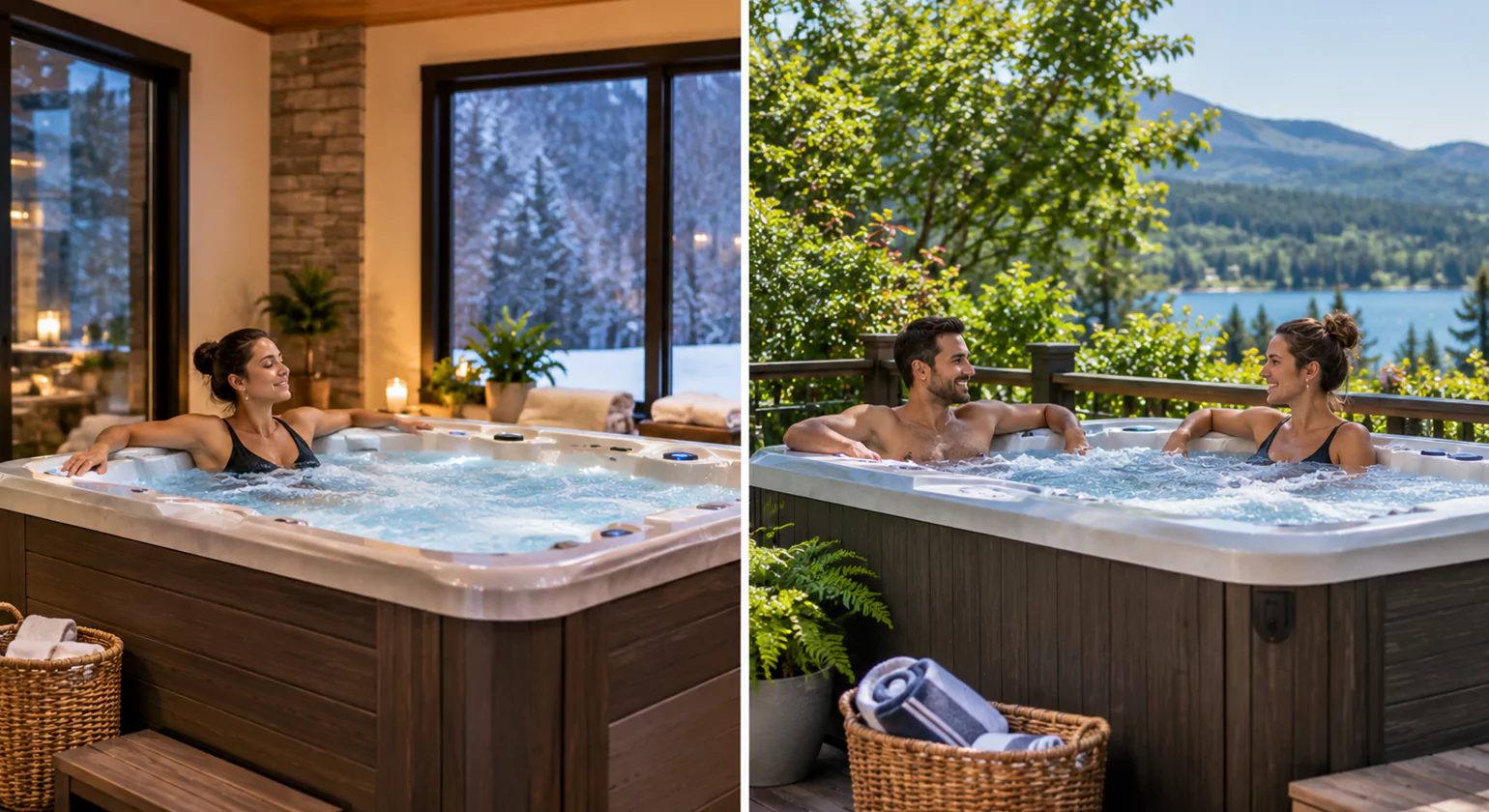
The two options differ enough in installation, weather exposure, and running costs that it’s worth laying them out side by side before you decide.
| Aspect | Indoor Hot Tub | Outdoor Hot Tub |
| Installation & Maintenance | Needs dedicated ventilation, moisture-resistant flooring, and often extra structural support to safely handle the water weight | Skips most of that since it’s built to face the elements directly, but still needs a solid, level foundation like concrete or reinforced decking |
| Privacy, Weather Exposure & Year-Round Use | Fully shielded from sun, rain, and salt air, but retrofitting a room for one later is a bigger, pricier project than most people plan for | Gives you that open-air feeling, but comes with direct exposure to sun, rain, and the salt air common along the Florida coast |
| Energy Efficiency | Comparable to outdoor models once insulation is factored in | Comparable to indoor models with decent insulation and a tight cover — the Department of Energy notes that lowering the temperature a couple degrees and covering it when unused cuts heating costs meaningfully |
| Best For | Homeowners prioritizing privacy from neighbors, or those in climates with harsher winters | Most Florida homes — simpler installation, doubles as entertaining space, usually lower upfront cost |
For most Florida homes, outdoors win out. Installation is simpler; it doubles as an entertaining space, and the upfront cost is usually lower. Indoors make more sense if privacy from neighbors a real concern is, or you live somewhere with harsher winters, which isn’t much of an issue here.
What to Consider When Buying a Hot Tub
Jets, seating, controls, and other features
Jets get a lot of attention in showrooms, but placement matters more than count. A tub with twenty jets aimed at the wrong spots won’t do much for a stiff lower back. Pay attention to where the jets sit relative to where you’ll actually be sitting. Smart controls and app-based monitoring are nice extras, but they’re not deal-breakers if you’re working with a tighter budget.
Energy efficiency and insulation
Insulation is where a lot of buyers get it wrong. Full foam insulation around the shell and plumbing holds heat far better than partial insulation, and the cover matters almost as much. A worn-out or ill-fitting cover is one of the most common reasons people see their energy bills creep up over time.
Materials, durability, and weather resistance
Materials matter too, especially here. Acrylic shells handle Florida’s sun and humidity well and generally offer more seating and jet configurations. Softer, portable-style spas cost less to start, but they tend not to hold up as long outdoors, especially with year-round UV exposure.
Warranty and after-sales support
Don’t skip the warranty conversation, and don’t just ask what’s covered. Ask who actually shows up when something breaks. A dealer with an in-house service team can usually get a technician out faster than one that outsources repairs to a third party.
Outdoor Hot Tub Installation and Maintenance
Foundation and electrical requirements
Most outdoor hot tubs need a flat, reinforced base, whether that’s concrete, pavers, or reinforced decking, plus either a dedicated electrical circuit or professional hard-wiring depending on the model. Worth noting: the Consumer Product Safety Commission recommends keeping water temperature at or below 104°F, a limit most newer spas are already pre-set to respect.
Drainage and ventilation considerations
You won’t need mechanical ventilation the way an indoor spa requires, but drainage around the base still matters. Standing water around the foundation can warp decking or erode the ground underneath over months of exposure.
Cleaning and water care
Day-to-day upkeep is more manageable than people expect. Filter cleaning, water balancing, and periodic draining keep things sanitary, and a lot of newer systems automate enough of that process that you’re not testing water chemistry every week.
Protecting your hot tub from weather and debris
The bigger risk in Florida is weather, not neglect. A locking, insulated cover handles falling leaves, heavy rain, and intense sun without much trouble. Come hurricane season, though, it’s worth checking with your dealer about securing or temporarily draining the tub ahead of a major storm. That’s not something to figure out the night before.
How to Choose the Best Outdoor Hot Tub for Your Home
Comparing features and prices
Price comparisons get tricky if you’re only looking at the sticker number. Two tubs at the same price point can have very different insulation quality, warranty terms, and expected energy costs, and those differences add up over years of ownership, not just at checkout.
Setting a realistic budget
Budget for more than the unit itself. Site prep, electrical work, delivery, and any surrounding hardscaping all add to the real project cost, and it’s easy to underestimate that total if you’re only pricing the spa. Financing helps here. Several South Florida dealers, including Jacuzzi South Florida, offer options that spread the cost out instead of requiring one lump payment.
Questions to ask before purchasing
Before you commit, ask a few pointed questions. What’s actually included in delivery and setup? Is installation part of the price or billed separately? How is warranty service handled locally, and by whom? And how long is the insulation and cover actually expected to last before it needs replacing?
Outdoor hot tub buying checklist
- Confirm your available space and foundation type
- Decide on seating capacity based on who’ll actually use it
- Compare insulation and cover quality across models, not just price
- Check permit requirements with your local building department
- Review warranty terms and who provides local service
- Budget for the full project, not just the unit price
Conclusion
An outdoor hot tub is one of the more approachable backyards upgrades you can make in Florida. It installs more easily than an indoor unit, gives you flexible placement options, and turns into a spot you’ll use year-round instead of a novelty that sits unused after the first month. The right pick comes down to matching size, build quality, and budget to how your household actually lives. If you’d rather see a few models in person before deciding, Jacuzzi South Florida’s Pompano Beach showroom has a full lineup on the floor, along with local installation and service support.
FAQs
In most South Florida cities, yes. Local building departments, Pompano Beach included, require a permit along with proof of an approved safety cover or barrier before your installation gets signed off.
It depends heavily on insulation quality, cover condition, and how often you use it, so ask your dealer for a model-specific estimate rather than trusting a generic number online. For more details, see our hot tub cost guide
For most homeowners here, yes. It fits naturally with how Florida homes already use outdoor space, and it skips the ventilation and structural work an indoor installation demands.
A well-built acrylic-shell model handles sun, humidity, and heavy rain without issue. The insulation and cover quality matter more than people assume for how well it holds up long-term.
Choose a size based on how many people will regularly use the tub. A two- or three-person model can suit couples, while larger models are better for families or homeowners who regularly host guests.
Plan for additional costs such as site preparation, electrical work, delivery, installation, and surrounding hardscaping. Comparing the full project cost helps you set a more realistic budget before purchasing.