
A hot tub is only as relaxing as the water inside it. Skip a few weeks of care and you’re not soaking, you’re troubleshooting. This guide breaks down everything you need for real hot tub maintenance: what to do daily, what to do weekly, and what to leave to a professional.
Key takeaways from this blog:
- Why maintenance matters for both your health and your equipment
- A simple daily, weekly, and monthly hot tub care routine
- Hot tub chemical maintenance, explained in plain language
- Equipment upkeep — filters, pumps, heaters, and covers
- A real-world example using the Jacuzzi® J-300™ Series
- A quick-reference checklist and answers to common questions
One thing worth deciding early: how much of this you want to handle yourself. Daily and weekly tasks are quick and don’t need special tools. Deeper equipment checks, water testing calibration, or troubleshooting a stubborn pump are usually better left to a technician, especially if your hot tub is still under warranty. If you’re in South Florida, a local Jacuzzi service team can handle the parts of maintenance you’d rather not.
Why Hot Tub Maintenance Matters
Hot tub maintenance is essential for keeping your water clean, your equipment running efficiently, and your overall maintenance costs are under control. There are three key aspects that fall under hot tub maintenance:
Health and hygiene. Warm water is an ideal environment for bacteria if it isn’t sanitized properly. The CDC notes that pool and hot tub owners are responsible for routinely testing and adjusting chlorine and pH levels, since properly maintained chlorine can kill most germs within minutes. Skip this step and you’re not just risking cloudy water — you’re risking skin irritation, ear infections, and worse.
Equipment protection. Pumps, heaters, and jets are built to run in balanced water. Neglected chemistry water that’s too acidic, too alkaline, or under-sanitized — corrodes metal components and clogs plumbing over time. A clogged filter forces your pump to work harder, which shortens its lifespan.
Lower long-term costs. Most hot tub repairs trace back to something preventable: a filter that went too long without cleaning, water that sat untested for weeks, or a cover that let in debris. A consistent routine is cheap. A replacement heater is not.
Daily, Weekly & Monthly Hot Tub Care Routine
Good hot tub care isn’t complicated once it becomes a routine. Here’s how to break it down.
Daily Hot Tub Care
Before you get in, a quick glance tells you most of what you need to check:
- Water clarity — cloudy water usually means low sanitizer or poor filtration
- Temperature — confirm it’s holding steady at your set point
- Cover condition — check that it’s sealed and free of standing water or debris
- Surface debris — skim out leaves, bugs, or anything floating
This takes under a minute and catches small problems before they become bigger ones.
Weekly Hot Tub Maintenance
Once a week, go a step further:
- Test water chemistry with test strips or a liquid kit (pH, alkalinity, sanitizer)
- Wipe down the waterline to remove oils and residue
- Rinse filters with a hose to clear loose debris
- Apply a shock treatment to break down organic contaminants that regular sanitizer misses
Monthly & Seasonal Maintenance
Monthly tasks take more time but matter just as much:
- Deep clean filters using a filter-specific cleaning solution, not just a rinse
- Flush the jets to clear built-up biofilm from the plumbing lines
- Check and, if needed, drain and refill the water — most residential hot tubs need this every 3 to 4 months, sooner with heavy use
- Prep for seasonal shifts: in Florida, that usually means managing higher bather loads and heat rather than freeze protection, but consistent testing matters more when the tub sees more use
Hot Tub Chemical Maintenance: Water Chemistry Explained
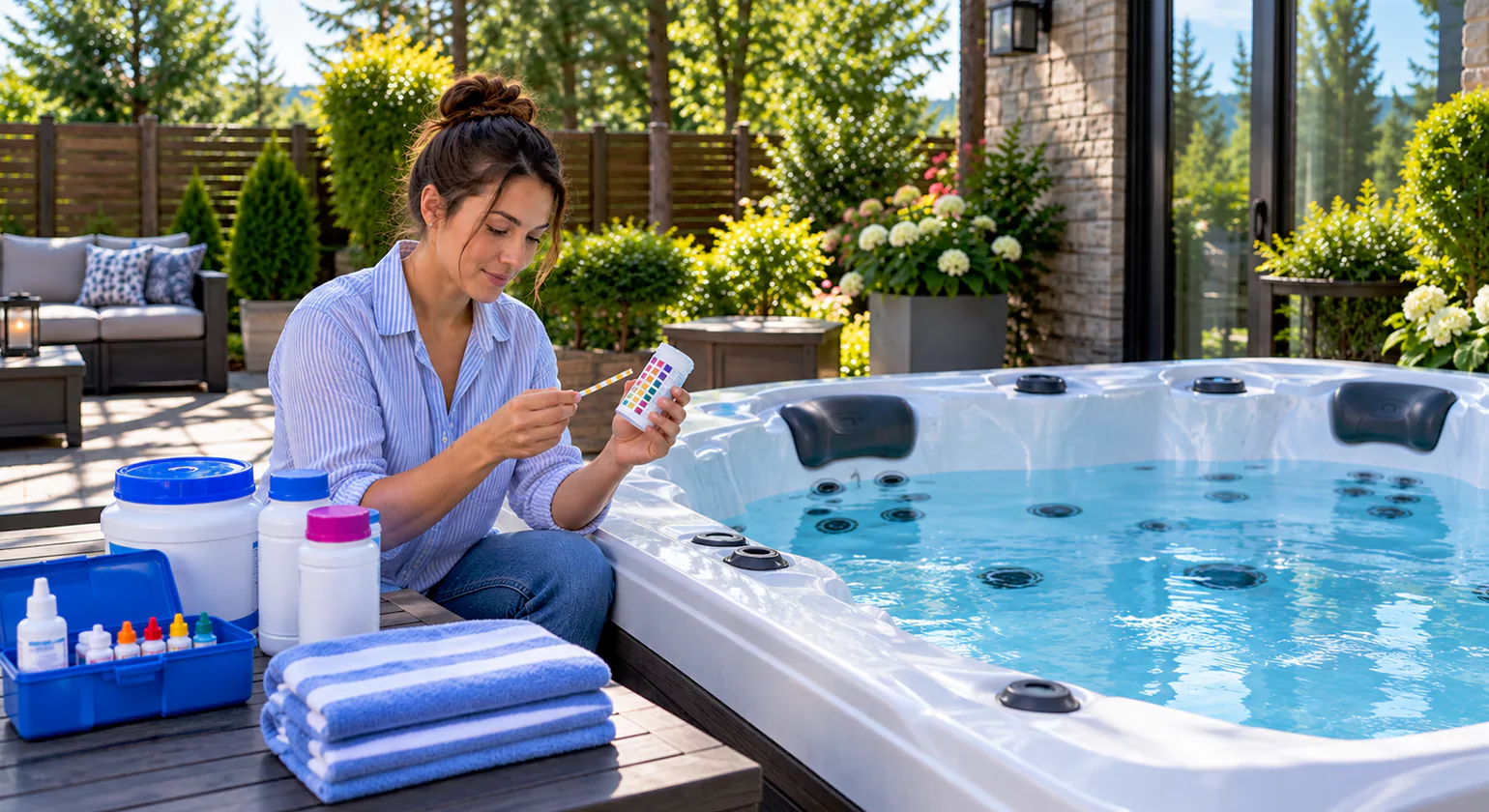
This is the part of hot tub care that trips up most new owners. Get it right and everything else — clarity, equipment life, comfort — falls into place.
Understanding pH, Alkalinity & Sanitizer Levels
Three numbers matter most:
- pH measures how acidic or basic the water is. The CDC recommends keeping pH between 7.0 and 7.8 for effective disinfection without damaging equipment.
- Total alkalinity acts as a buffer that keeps pH from swinging wildly. Aim for 80–120 ppm.
- Sanitizer level — chlorine or bromine — is what actually kills bacteria. The CDC recommends a minimum chlorine concentration of at least 3 ppm in hot tubs, higher than what’s needed in pools because of the warmer water and higher bather load per gallon.
Test these at least twice a week, more often if the tub sees frequent use or guests.
Chlorine vs. Bromine vs. Saltwater Systems
- Chlorine works fast and is the most widely used option, but it has a stronger smell and needs more frequent monitoring.
- Bromine is gentler on skin and more stable at higher temperatures, making it popular for hot tubs specifically, though it costs more per treatment.
- Saltwater systems generate sanitizer automatically from dissolved salt, cutting down on manual dosing. Several manufacturers, including Jacuzzi’s True Water™ system, now offer low-chemical water care that automates much of this process.
When to Use Hot Tub Shock Treatments
Shock treatment oxidizes the organic waste — sweat, lotion, body oils — that regular sanitizer doesn’t fully break down. Shock weekly under normal use, and always after a heavy-use session like a party or several consecutive soaks.
Common Chemical Maintenance Mistakes to Avoid
- Adding chemicals without testing first
- Mixing chlorine and bromine products in the same water
- Ignoring alkalinity and only watching pH
- Overdosing sanitizer to “catch up” after skipping tests
- Not letting chemicals fully circulate before getting in
Hot Tub Equipment Care & Maintenance
Water chemistry keeps the water safe. Equipment care keeps the system running.
Cleaning and Replacing Hot Tub Filters
Filters trap debris before it reaches your pump and heater. Rinse them weekly, deep clean them monthly with a filter cleaner, and replace them roughly once a year — sooner if you notice reduced water flow or persistently cloudy water even after balancing chemistry.
Maintaining Pumps, Heaters & Jets
- Listen for unusual noises from the pump, which often signal a failing motor or debris in the impeller
- Check that jets deliver even pressure across all seats; weak jets can mean a clogged line or air lock
- Keep the heater’s flow sensor clean, since dirty flow sensors are a common cause of “no heat” error codes
Hot Tub Cover Care and Insulation
A cover does more than keep debris out — it holds in heat and cuts your energy costs. Wipe it down monthly, treat the vinyl with a UV-protectant, and watch for waterlogging or cracking, both signs the internal insulation is failing, and the cover needs replacing.
DIY Maintenance vs. Professional Hot Tub Service
Handle daily and weekly tasks yourself. Bring in a professional for:
- Annual deep cleaning and equipment inspection
- Diagnosing recurring error codes
- Component replacement (heaters, pumps, circuit boards)
If you own a Jacuzzi model, the official service guide outlines the manufacturer-recommended schedule, and a certified technician can walk through it with you during a routine visit.
How to Maintain a Jacuzzi® J-300™: Practical Maintenance Guide
Checklists are easier to follow with a real example. The Jacuzzi® J-315™, part of the J-300 Series, is one of the brand’s most popular compact models — built for two to three people and a common choice for owners with smaller patios or first-time buyers.
Filter Cleaning and Replacement
The J-315 uses a standard cartridge filtration system. Rinse the cartridge weekly, soak it in the filter cleaner monthly, and plan to replace it annually under normal use. Owners running the tub daily should shorten that cycle every 9–10 months.
Chemical and Water-Care Routine
Many current Jacuzzi® models, including options in the J-315 Series, can be paired with the brand’s True Water™ system for lower-maintenance, largely chlorine-free water care. If you’re running a standard chemical routine instead, the same pH (7.0–7.8) and sanitizer targets covered above apply directly.
Water Change and General Maintenance Schedule
For a two-to-three-person tub used several times a week, expect to fully drain and refill every 3 months. Lighter use can stretch that to 4 months. Always confirm the exact figures against your model’s current owner’s manual, since specifications and recommended systems can be updated between production runs — the team at you local Jacuzzi showroom can confirm what applies to your specific unit.
Hot Tub Maintenance Checklist
Daily, Weekly, Monthly & Seasonal Maintenance Checklist
| Frequency | Tasks |
| Daily | Check clarity, temperature, cover seal, and skim debris |
| Weekly | Test chemistry, wipe waterline, rinse filters, shock the water |
| Monthly | Deep clean filters, flush jets, inspect cover condition |
| Every 3–4 months | Drain and refill water, replace filter if worn |
| Annually | Schedule a professional inspection and filter replacement |
How Often Should You Change Hot Tub Water?
Most residential hot tubs need a full water change every 3 to 4 months. Heavier use, more bathers, or skipped chemical maintenance shortens that window.
Can You Use Pool Chemicals in a Hot Tub?
Not directly. Pool chemicals are formulated for larger volumes of cooler water and lower bather density. Hot tubs run hotter and with more people per gallon, so dosing needs differ — always use products labeled for spas and hot tubs.
How Much Time Does Hot Tub Maintenance Take?
Daily checks take under a minute. Weekly tasks run 10–15 minutes. Monthly deep cleaning takes closer to 30–45 minutes. Spread across a month; that’s a small-time investment for consistently clean, safe water.
Is Hot Tub Maintenance Expensive?
Routine supplies — test strips, sanitizer, filter cleaner — typically cost a modest amount per month. The real expense comes from neglect: a pump or heater replacement costs far more than years of consistent upkeep.
Conclusion
Hot tub maintenance isn’t a single big task — it’s a handful of small habits repeated consistently. Daily glances, weekly testing, monthly deep cleans, and water change every few months will keep your equipment running longer and your soak genuinely relaxing. If a step ever feels beyond a quick DIY fix, that’s what professional service is for.
FAQs
Every 3 to 4 months for most residential hot tubs, depending on usage.
No — use products formulated specifically for spas and hot tubs, since dosing and water volume differ from pools.
Daily checks take seconds; weekly care takes about 10–15 minutes; monthly deep cleaning takes under an hour.
Routine supplies are inexpensive. The real cost comes from skipping maintenance and needing equipment repairs later.
Once a year is standard for most owners, even with consistent DIY care. A technician can catch wear on pumps, heaters, and seals before it turns into a bigger repair — worth booking through your local Jacuzzi service team if you’re not confident checking these yourself.
Cloudy water usually points to a filtration problem rather than a chemistry one. Check the filter first — it may need a deep clean or replacement — since balanced water can still look cloudy if debris isn’t being properly filtered out.
For short trips, leave it running with the cover secured; the filtration and sanitizer system is designed to maintain itself for a couple of weeks. For hurricane season in Florida, it’s worth checking your model’s storm guidance, since some owners choose to drain and secure the tub ahead of a major storm rather than risk