
What is a swim spa, in plain terms? It is a heated vessel that combines a swimming pool and a hydrotherapy spa in one shell. It holds a pool’s worth of water in a fraction of the footprint, generates a current you swim against without moving forward, and keeps a seating area at soaking temperature at one end.
The practical difference between a swim spa and a pool is not size. It is that you never turn around. A pool gives you the length of the pool. A swim spa gives you the length of your stroke, repeated for as long as you keep going. Twenty minutes in one is twenty continuous minutes of swimming, not twenty broken up by wall turns.
The swim spa installation market was worth $3.55 billion in 2025 and is forecast to reach $5.1 billion by 2030, a 7.6% annual growth rate, according to The Business Research Company, while the broader market runs from $5.2 billion to $8.4 billion across the same decade. The hot tub market grows at under 4%. Installation is outgrowing the product, and the constraint moved with it. Buyers are not short of swim spas. They are short of people who can put one in properly.
Types of Swim Spas, Swim Spa Sizes and How Deep a Swim Spa Is
Splitting the category into 3 parts is the fastest way to answer “what is a swim spa?” for your own yard. Buyers usually hear the three out of order.
How the current is made.
Jet-propulsion systems push water through a shaped jet for a broad, even stream. Propeller-drive systems turn an impeller for a wider, steadier lane at higher speed. Jet systems suit fitness swimming, aqua jogging, resistance walking and aerobics; propeller systems cost more and suit lap training. Jacuzzi builds three tiers: PowerPlay, PowerActive with AX swim jets that flatten the flow into a shoulder-width lane, and PowerPro with fully adjustable jets and four 3HP pumps on the largest model, moving 4,104 litres a minute.
How the temperature is zoned.
A single-zone swim spa holds one temperature throughout. A dual-temperature model splits the shell, so one person swims in cooler water at the far end while another soaks in hot water at the near end. The J-19DT is the dual-zone model in our range.
How it is installed.
Above ground on a prepared pad is the most common and least expensive. Partially recessed into a deck looks the most integrated. Fully in-ground is the most involved and the fastest-growing installation type.
How deep is a swim spa?
Shell height on a Jacuzzi swim spa runs from 50 to 53 inches. Water depth is lower, because the waterline sits below the rim. Across the category, a standard swim spa has a shell of around 51 inches and roughly 42 inches of water, while deep models go to a 60-inch shell and about 51 inches of water. Buyers read 53 inches on a spec sheet and picture five feet of water. Stand in the model before you buy.
Swim spa sizes
Swim Spas come in various sizes; for example, the J-13 PowerPlay is 149 inches long and 50 inches tall, the shortest and lowest profile we sell. The J-14 is 172 inches. The J-16 is 185 inches. The J-19 and J-19DT run to 220 and 221 inches. Usable swim area is not proportional to overall length, and the difference is larger than buyers expect: 112 inches on the J-16 against 148 inches on the J-19. Water volume runs from 1,628 gallons to 2,432 gallons across the range. If anyone in the household is over six feet tall, 16 feet is the practical minimum length.
Swim Spa vs Pool vs Hot Tub
The swim spa vs hot tub question and the swim spa vs pool question come up in almost every showroom conversation, and the answer to both is that they do different jobs.
Swim spa vs. hot tub.
A hot tub is built for soaking. It holds four to eight people in contoured seats with targeted massage jets, sits on a small pad or an existing deck, and does one thing well. A swim spa adds a swim lane, a current and a soft-stride mat for standing exercise. It costs more upfront, needs a 240V circuit rather than a plug, and takes more yard. If relaxation is the whole plan, a hot tub is the better buy and we will say so. If someone in the house wants to swim, exercise or rehab a joint, only the swim spa of the two can do it.
Swim spa vs pool.
A pool wins on space and company. Two people can swim side by side, children can play, and a group can gather without waiting a turn. A pool also costs more to build, heat, treat and clean, and in most of the world it is seasonal. A swim spa removes the wall turn, which changes the workout. The effort is continuous, closer to open-water swimming than to laps, and you decide when to stop rather than the pool deciding for you. It uses less water, fewer chemicals and less electricity.
The deciding question is how you will use the water. A family that wants a social centre buys a pool. A household where one or two people want to swim, train or recover four or five times a week buys a swim spa, and tends to find it gets used more than a pool would have.
What Is the Cost of a Swim Spa?
Expect $25,000 to $70,000 for the unit alone in 2026, and $26,000 to $75,000 once delivery, base, electrical and permits are included. Compact plunge-style models start closer to $13,000.
The all-in figure hides the part that varies by site.
| Line item | Typical range |
|---|---|
| Swim spa unit | $25,000 to $70,000+ |
| Delivery, crane if access is tight | $100 to $1,500 |
| Concrete pad or engineered base | $6 to $12 per square foot |
| Installation labour, above ground | $4,000 to $5,000 |
| Installation labour, in-ground | $10,000 to $30,000 |
| Electrical, 240V dedicated circuit | $1,000 to $2,000, more on a long run |
| Permits | $100 to $2,500 by municipality |
| Decking and surround | Quoted with the landscape |
How much does a swim spa cost in Florida depends on 3 things more than on the model. The distance from your electrical panel to the installation point sets the electrical figure, and a run across a property is a different job from one through a wall. The route from the street decides whether a crane is needed, which adds $300 to $1,500 depending on reach. Whether the spa sits on an existing slab or needs a new engineered pad decides the base cost.
Two ways to reduce the number without cutting quality. Site the spa near the panel and the street entrance, because both are free to plan and expensive to retrofit. Then choose the collection rather than the options. A J-19 in the PowerActive tier carries the same shell, frame, insulation and filtration as the PowerPro tier, and the difference sits in the current system you may or may not need.
Running costs sit well below a pool. Expect $50 to $150 a month in electricity for a heated swim spa in South Florida against $100 to $300 for a comparable pool, because you are heating 1,600 to 2,400 gallons rather than 15,000.
Our financing options include a Wells Fargo Home Projects account. Ask in the showroom for current terms. If you are weighing the whole outdoor project, what a hot tub costs in Florida sets out the same line items for a smaller installation.
Pros and Cons of Swim Spas
The pros and cons of swim spas only mean something once you have decided what is a swim spa for: fitness, recovery, or somewhere to sit at the end of the day. The honest list is shorter than most pages suggest.
Where a swim spa wins.
It is usable every day of the year, which a pool in most climates is not. It fits where a pool will not, often in a garden a quarter the size. It combines exercise and hydrotherapy in one unit, so a workout and a recovery session do not need two purchases. It costs less to run and less to maintain, because the water volume is smaller and the filtration runs continuously. It installs in days rather than months.
What to weigh against it.
The swim lane fits one adult, so two people who want to train together need a pool. A jet system has a speed ceiling, and a strong swimmer will outpace most within a season, which makes the swim spa a fitness tool rather than a training venue. At 50 to 53 inches tall with roughly 42 inches of water, it is not for diving and it is not a play pool for small children without supervision and a compliant barrier. It costs more than a hot tub, needs a dedicated 240V circuit and a properly engineered base. And it demands a discipline that is easy to underestimate: a swim spa you do not swim in is an expensive soaking tub.
Where the health claims are real.
Warm-water exercise is not marketing. A 2023 systematic review in the Journal of Orthopaedic Surgery and Research found aquatic exercise improved pain, physical function and quality of life against no exercise in adults with chronic musculoskeletal conditions, and improved pain specifically when compared with land-based exercise. A review of systematic reviews found small but statistically significant short-term pain relief for arthritis, rheumatoid conditions and low back pain. Both papers are careful about long-term effects, and so are we. The evidence supports warmth and movement in water, not a promise about your particular back.
Who a swim spa is not for.
A household that wants a party pool, a household that will not use it more than twice a month, and a household buying on price alone. If any of those describe you, a hot tub or a pool is the better answer, and we would rather say so than sell you the wrong product twice.
How to Choose a Swim Spa, the Best Swim Spa Brands and Swim Spa Dealers
How to choose a swim spa comes down to seven checks, and they take one visit.
- Swim it. Ask whether the showroom has a filled model you can get into. Current feel varies more between models than any spec sheet conveys, and a current that pushes you sideways is one you will stop using.
- Measure the usable swim area, not the shell. A 185-inch spa and a 220-inch spa do not differ by 35 inches of swimming. They differ by the distance from the jets to where your stroke breaks down.
- Check the seating. Seat count is a maximum. A six-seat model seats four adults. Ask which positions are corner seats and which are bench runs.
- Look at insulation and frame. Full-foam insulation and a galvanized steel frame decide the running cost and the service life, and neither can be added later.
- Confirm the water care system. Continuous circulation with CLEARRAY treatment means less chemical work each week.
- Ask who services it. A swim spa is a long-term relationship, not a one-time sale.
- Check the cover. Covers sit outside the warranty on the acrylic collections because they are wear items. Budget for at least one replacement.
On the best swim spa brands, judge any maker on four things rather than on reputation. Whether the warranty is published per collection and available before you buy, because terms differ within a brand. Whether it separates parts from labor, because the labor row is where products that look identical diverge. How long the maker has been building them. And whether there is a service network where you live. Jacuzzi has manufactured for 65 years, builds in five countries and sells in more than 100, and publishes a separate warranty for each collection.
Choosing among swim spa dealers is the part buyers underweight. A swim spa is delivered, positioned, wired, commissioned and then serviced for years, and the dealer decides how most of that goes. Judge one on whether it has a showroom and a service operation rather than a storage address, whether it will look at your site before quoting, whether the models on display are filled, and how long it has carried the brand.
Swim Spa Installation in South Florida
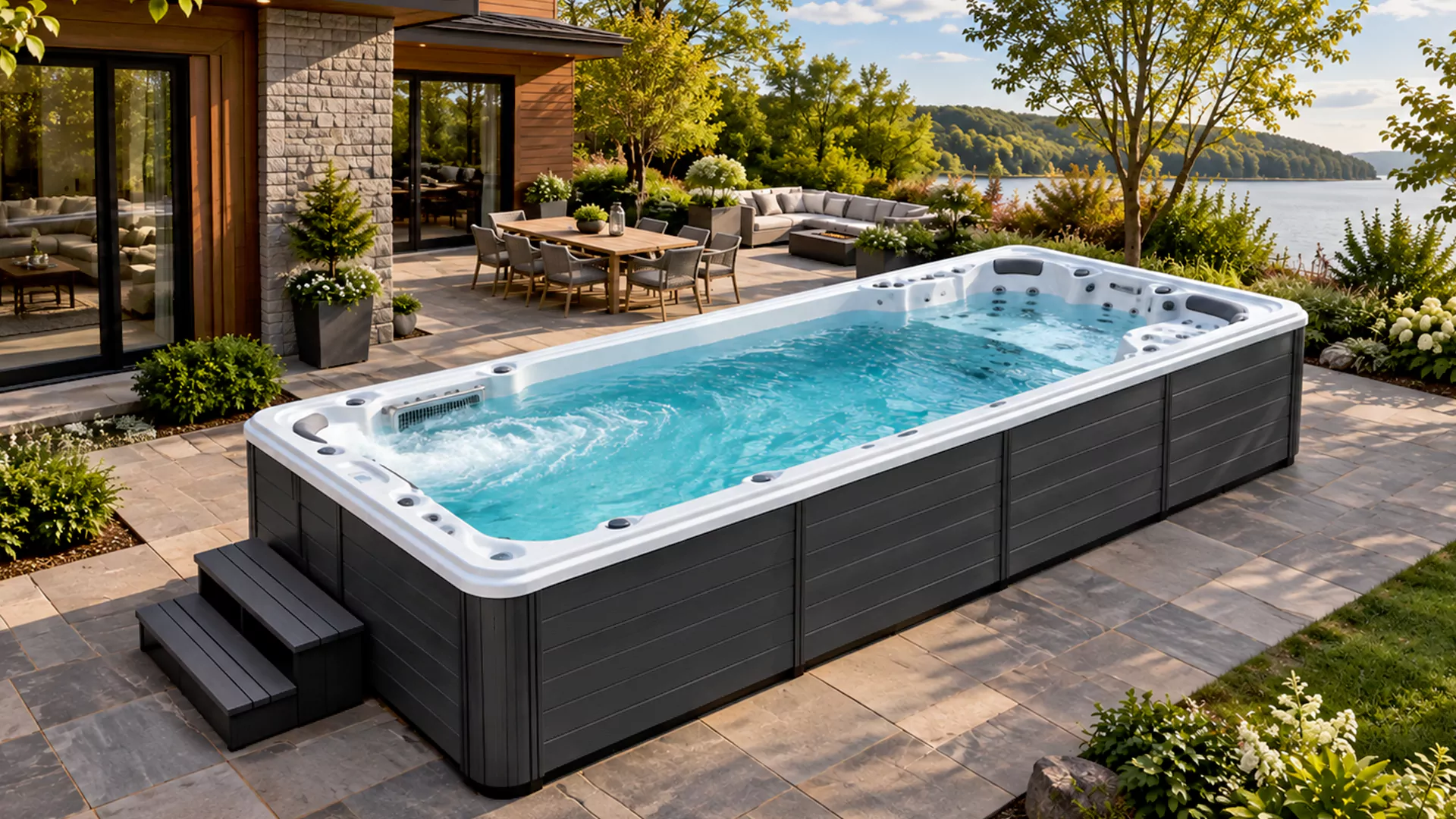
Swim spa installation is where projects go right or wrong, and in Florida it involves the Building Code in ways buyers do not expect.
The site survey comes first.
Measure the narrowest point on the route from the street, usually a side gate, the gap between house and fence, or a corner turn. Every model in our range is 92 inches wide, so those points need more than that, and moving equipment adds width. Check overhead for service lines and tree limbs, because a crane lift needs a clear path over the roofline.
The base is not a slab of convenience.
A filled J-14 weighs 15,718 pounds and a filled J-19 weighs 22,948 pounds, before anyone gets in. That load needs an engineered pad or a properly designed deck, confirmed before the unit is ordered rather than after it arrives.
Electrical is a permitted job.
Our swim spas run on 240V, 60A with GFCI protection, which means a dedicated circuit and a licensed electrician. Chapter 42 of the Florida Building Code governs the work, and a pool holding water deeper than 42 inches, or installed partly in the ground, is classed as permanently installed. That brings bonding and clearance rules with it: overhead power conductors at least 22.5 feet above the water, communications cables at least 10 feet, underground wiring no closer than 5 feet horizontally from the inside wall unless it supplies the equipment, and a maintenance disconnect within sight at least 5 feet from the water.
Permits depend on the installation.
A new dedicated circuit requires an electrical permit, including on a simple above-ground unit, because new circuits are always permitted. Structural work, meaning a new pad, decking, a surround or an in-ground installation, requires a building permit as well. Under Florida Statute 515, a spa that can hold water deeper than 24 inches is treated as a residential swimming pool for safety purposes, which brings barrier requirements into play.
Salt air is a South Florida detail.
Within a few miles of the coast it reaches fasteners and hardware quickly. Synthetic cabinetry and a galvanized steel frame resist it, and cabinet material is one of the few decisions in this purchase that cannot be revisited later.
Then the surround. A swim spa dropped on a pad and left at that looks like equipment. One with stone or porcelain decking meeting the cabinet cleanly, a matching step and a coping detail looks like it belongs to the house. If the spa is part of a wider project, fix the layout before the pad is poured.
Jacuzzi Swim Spas and Real South Florida Installations
The best way to close a guide on what is a swim spa is with the three projects we build most often, described by the constraint that shaped each one. All three use real specifications from our swim spa range. What they share is the shift the trade press is reporting, where homeowners ask for water built for swimming rather than general water.
The training household.
One or two adults who swim before work and want a current they can hold a set against. This is a J-19 or J-16 in the PowerPro tier, on a pad close to the house so the walk is short at six in the morning. The J-16 gives 112 inches of usable swim area at 185 inches overall; the J-19 gives 148 at 220. The fully adjustable current also supports aqua jogging and resistance walking on the soft-stride mat, so a household with one swimmer and one exerciser does not need two products.
The compact garden.
A property where the outdoor space is already committed to a terrace and a pool is off the table. This is the J-13 PowerPlay, 149 inches long, 92 inches wide, and 50 inches tall, with seating for up to eight. It is the lowest profile in the range, which matters when there is a neighboring sightline to respect, and it often goes partially recessed into an existing deck.
The two-temperature household.
A couple where one wants to swim at 84 degrees and the other wants to soak at 102. This is the J-19DT PowerActive, which holds two temperatures in one shell across 221 inches, with 45 jets and seating for six. It settles an argument that has ended more swim spa projects than budget has.
One thread runs through all three. The spa is specified against the site, not chosen from a catalogue and fitted around afterwards. Access, base, electrical run and sightlines decide which model works, and those decisions are cheap at the start and expensive later. If you would like the documents before you visit, we publish every collection warranty, along with the owner manuals and specification sheets, on our owner resources page.
FAQs
1. What is a swim spa in simple terms?
A swim spa is a heated pool with a current you swim against in place, combined with a hot tub’s seating and massage jets in the same shell. It is shorter than a pool and longer than a hot tub, typically 12 to 20 feet, and the current replaces length so you never turn around. Most models hold seating at one end and an open swim lane at the other. Dual-temperature versions keep the two ends at different temperatures, so one person can swim while another soaks.
2. How deep is a swim spa?
A standard swim spa has a shell 50 to 53 inches tall with roughly 42 inches of water, and deep models reach a 60-inch shell with about 51 inches of water. Shell height is the outside measurement, so the water level sits several inches lower than the number you read. That is enough for swimming, aqua jogging, resistance walking and standing exercise, but not for diving. If you are tall, stand in a filled model before comparing numbers.
3. How much does a swim spa cost in Florida?
Expect $26,000 to $75,000 installed, with the unit accounting for $25,000 to $70,000 of that. The rest is delivery, a pad or engineered base, a dedicated 240V circuit and permits, which together run $2,000 to $10,000 depending on the site. Two things move the figure most in South Florida: the distance from the electrical panel to the installation point, and whether access needs a crane, which adds $300 to $1,500.
4. Is a swim spa better than a pool?
For one or two people who want to swim, train or recover daily in a small space, a swim spa is better and costs less. For a family that wants to host, swim side by side or have children play in the water, a pool is better. The deciding factor is not budget, but how many people will be in the water at once and what they will be doing.
5. What is the difference between a swim spa and a hot tub?
A hot tub is built for soaking, holds four to eight people, and fits on a small pad or deck. A swim spa adds a swim lane and a current, is 12 to 20 feet long, and needs an engineered base and a dedicated 240V circuit. It costs more and does more. If relaxation is the only goal, a hot tub delivers it for less. If anyone needs to swim or exercise in the water, only a swim spa will do.
6. Do you need a permit to install a swim spa in Florida?
Yes, in almost every case, and at minimum an electrical permit. A new dedicated 240V circuit always requires one, even on a simple above-ground unit. Structural work, including a new pad, decking, a surround or an in-ground installation, requires a building permit as well. Under Florida Statute 515, a spa holding water deeper than 24 inches is treated as a residential swimming pool for safety purposes, so barrier rules apply too.
7. Can you swim properly in a swim spa?
Yes, against an adjustable current, and the stroke is continuous rather than broken up by wall turns. Water resistance is roughly 12 times that of air, so a moderate current produces real work. The limit is speed: a strong swimmer will outpace most jet-driven systems within a season, which is why higher-output tiers exist. Serious lap training suits those. Fitness swimming, aqua jogging and rehabilitation work well on all of them.
8. How much space does a swim spa need?
A swim spa needs a base the size of its footprint plus clearance for the cover, the equipment door and service access, and the route from the street has to clear it too. In practice, a 12 to 20-foot unit needs an installation area around 15 by 10 feet, and at least 16 feet of length if anyone is over six feet tall. Measure the route before the garden, because its narrowest point decides whether you need a crane.
9. Do swim spas increase home value?
They can, and the effect shows up at the upper end of the market. Market analysis reports that properties with a professionally installed swim spa command a 4 to 6% premium in comparable analyses, that 34% of luxury showings highlighted one in 2025 and 2026 against 12% in 2019, and that builders in Florida increasingly include swim spa installations above $1.5 million. The premium attaches to a completed, integrated installation rather than a unit on a pad, so decking, screening and a clean surround are part of the value.
2 Responses